
How Model-Based Definition Supports Industry 4.0 Initiatives
As industry grows more connected and automated, the need to share clean data between systems becomes greater than ever. Modern manufacturing stands to benefit massively from the smoother, more reliable data flows enabled by model-based definition – an approach that embeds product manufacturing information (PMI) directly in 3D CAD models rather than in separate 2D drawings.
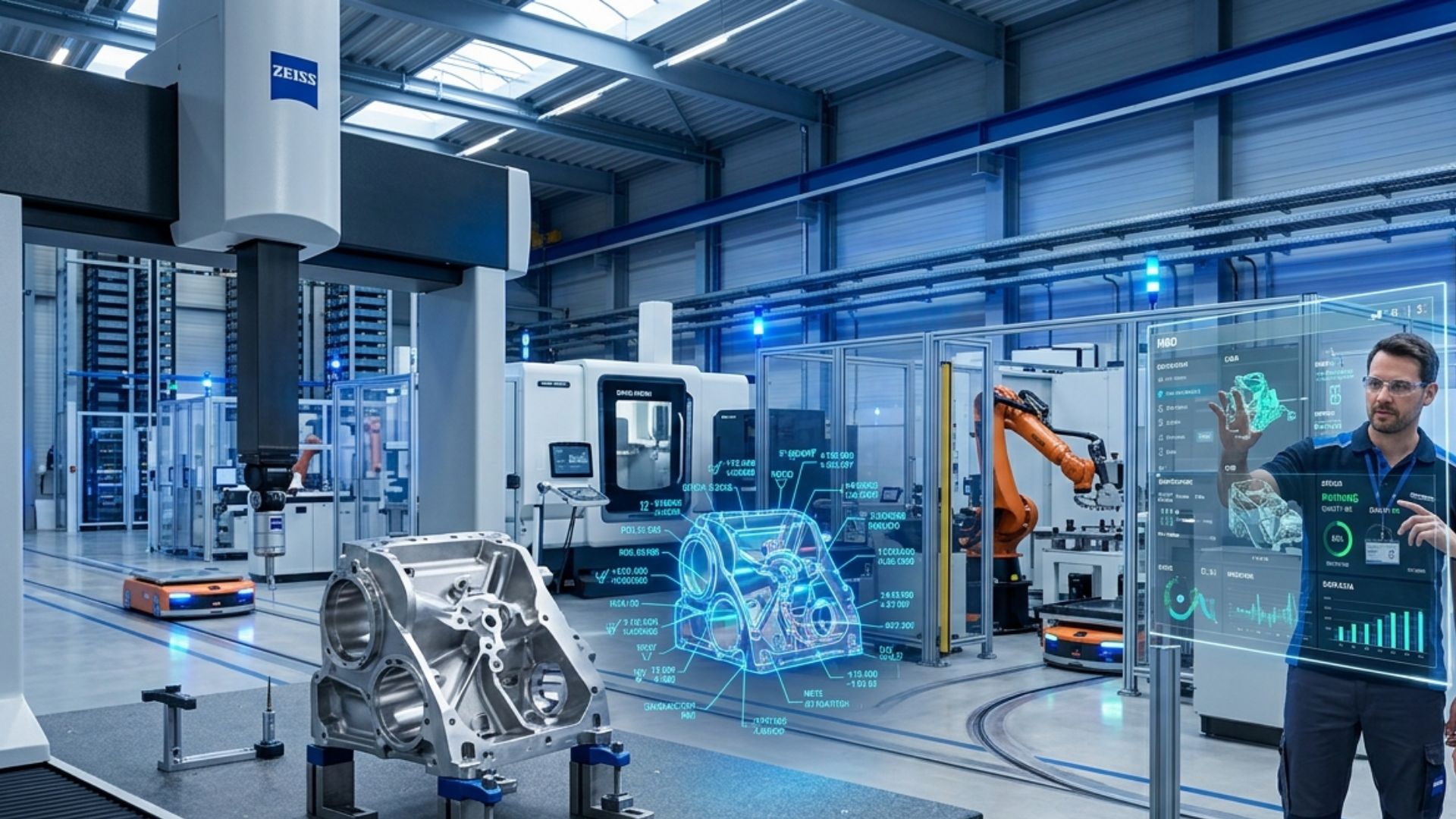
Table of Contents:
- What is Model-Based Definition?
- Industry 4.0 and the Digital Manufacturing Landscape
- The Role of MBD Across the Digital Thread
- How MBD Enables Automation Within Smart Manufacturing
- Why Manufacturers Should Use MBD for Industry 4.0
- Challenges When Using MBD for Industry 4.0 – And How To Address Them
- Conclusion
Model-based definition (MBD) gives manufacturers the ability to encode PMI directly inside 3D models. This lets downstream systems access critical product and manufacturing data directly, enabling faster production cycles, more reliable automated processes, and increased overall connectivity throughout the digital thread. This seamless workflow also complements 3D Model Printing Service solutions by ensuring highly accurate digital models are ready for production.
In short, it lets manufacturers lay the groundwork for a truly connected smart factory.
What is Model-Based Definition?
Model-based definition is an approach to product development in which the 3D CAD model is the sole repository of product and manufacturing information.
By embedding PMI directly in the 3D model, manufacturers can move away from drawing-based processes and their associated manual re-entry and interpretation of data. MBD supports a variety of PMI standards, including geometric dimensioning and tolerancing (GD&T), enabling the capture of manufacturing-specified requirements directly in the model. This makes the information much more accessible to downstream computer-aided manufacturing (CAM) and automated inspection systems that may be used in an Industry 4.0-connected environment. A growing number of standards across disciplines – including ASME Y14.41 – specify how such product data should be captured, organized, and represented in order to be most useful to other stakeholders.
Industry 4.0 and the Digital Manufacturing Landscape
As mentioned, MBD is a critical step toward fully realizing the potential of Industry 4.0 in modern manufacturing. Industry 4.0 is the concept of an interconnected production environment in which automated systems are used extensively to enable smart manufacturing practices. The various technologies and methods that fall under this umbrella have one thing in common: they rely on structured, easily accessible data to do their jobs. This is why MBD is such a valuable enabler – it encodes the PMI as structured data that can be accessed, read, and utilized by other computer systems.
Take digital twins as an example – these virtual replicas of real-world products and production systems require extensive product data to function. Connected, automated inspection and machining require structured, machine-readable PMI in order to operate. Industry 4.0 systems also feature greater supply chain connectivity, wherein automated systems communicate with one another across organizational boundaries – yet without standardized data representation and exchange, such connections are impossible to achieve. In order to be used by any of these technologies, product data must be accessible, standardized, and machine-readable. That’s precisely what MBD enables.
The Role of MBD Across the Digital Thread
Model-based definition plays a critical role throughout the digital thread, serving as a central repository of product and manufacturing information.
It helps to establish the digital thread in the following ways:
Single Source of Truth
With MBD, manufacturers can encode all of the information that would traditionally be found in 2D engineering drawings directly in the 3D model. This enables downstream manufacturing and inspection systems to consume that information without extra steps like manual data entry or interpretation.
Data Continuity
By capturing all of that data within the 3D model in a structured, standardized way, MBD ensures greater data continuity throughout the product’s lifecycle, from initial design through inspection and beyond.
Traceability
This same principle also supports traceability, as the relevant data is captured directly within the 3D model.
How MBD Enables Automation Within Smart Manufacturing
In its most basic sense, MBD is about encoding PMI as structured data that can be accessed directly by downstream systems.
However, in order to do that effectively, the PMI needs to be correctly specified and entered into the model by the designer. Doing that properly unlocks a number of automation capabilities within smart manufacturing environments. With the right PMI, manufacturers can take advantage of the following time- and cost-saving automated processes:
Automated CAM Programming
Computer-aided manufacturing software can be programmed to read certain PMI data fields and apply them directly to manufacturing programs, shortening cycle times and reducing the possibility for human error.
Inspection Planning and Automated Measurement
By embedding GD&T data directly into the 3D model, coordinate measuring machines (CMMs) and other automated inspection equipment can be programmed to perform dimensional inspections based on that data automatically, removing the need for manual interpretation of 2D engineering drawings.
Reduced Interpretation in Set Up
When operators or automated systems refer to the 3D model as their reference point, they are much less likely to encounter the kinds of ambiguities and inconsistencies inherent to 2D drawings.
Closed-Loop Manufacturing
When inspection equipment is used to collect dimensional data, that data can be used to drive subsequent manufacturing processes, forming a closed-loop quality control system. Again, this requires the ability of automated systems to access the correct data – which is much more straightforward when that data is embedded directly in the 3D model.
Why Manufacturers Should Use MBD for Industry 4.0
The ability of MBD to encode manufacturing-specified data as structured information within the 3D model has a number of additional benefits for manufacturers engaged in Industry 4.0 initiatives. When used in conjunction with a product lifecycle management (PLM) system, it allows for greater collaboration between design, manufacturing, and quality teams by providing a shared source of truth. This collaborative workflow also benefits organizations involved in Scale Model Building , where accurate digital information is essential throughout every stage of production. When engineers make changes to the model, those changes are automatically reflected downstream, reducing the time spent on design changes and reducing the possibility for errors when interpreting 2D documentation. Because downstream processes rely on data embedded directly in the 3D model, manufacturers can also shorten cycle times and increase overall efficiency. Meanwhile, by reducing design and process errors and providing richer data for inspection, MBD reduces the likelihood of costly late-stage design changes and quality issues.
Finally, by laying the groundwork for connected, automated manufacturing processes, MBD also enables manufacturers to reap the benefits of digital twins and other connected systems. These are powerful tools for simulation and predictive analytics, but they require substantial amounts of structured data to function effectively – which is precisely the kind of data that MBD embeds directly in the 3D model.
With that in mind, let’s look at some of the challenges manufacturers may encounter when using MBD to support Industry 4.0 initiatives.
Challenges When Using MBD for Industry 4.0 – And How To Address Them
The potential benefits that MBD can provide to manufacturers engaging in Industry 4.0 initiatives are difficult to ignore – however, the transition to model-based processes can sometimes be challenging, especially when compared to traditional paper-based or 2D CAD-based approaches. Organizations that understand and prepare for these challenges can much more easily realize the benefits of MBD for their business.
Resistance to Change
One of the greatest obstacles to implementing new methodologies in manufacturing is resistance to change itself. If your team is used to working in a certain way – and that way has served them well – there may be little incentive to change things up just for the sake of it. However, the long-term benefits of model-based definition far outweigh the costs of switching.
To overcome this challenge, consider gradually rolling out MBD across your organization. Focus on a specific product line or set of processes that will benefit from it most, then build on that success by demonstrating the value it has provided to your business.
Skills Gaps
Many manufacturers are not familiar with how to effectively leverage the various PMI tools available in 3D CAD software. Companies working with a Scale Model Making Company can also benefit from proper model-based workflows that improve design accuracy and collaboration.
This challenge can be addressed through proper training. Training should be provided for every role in your organization that interacts with model-based data, including design, manufacturing, and quality teams.
Software Interoperability
The promise of Industry 4.0 is largely based on systems connecting and sharing data across organizational boundaries. However, if every manufacturer uses different software, the ability to do that is significantly curtailed. This is also a problem within individual organizations – disparate software solutions create unnecessary barriers between departments.
To address this challenge, look at your software ecosystem holistically and identify areas in which interoperability is a concern. Then, work to standardize, wherever possible, around solutions that can support model-based processes effectively.
Lack of Readiness Among Suppliers
The challenge of interoperability also extends to suppliers, who must be equipped to interpret model-based data appropriately in order to take full advantage of it.
This issue can be mitigated with proper planning and early engagement with suppliers to ensure they are prepared to meet the new requirements.
With these challenges addressed, manufacturers can begin to see the full potential of model-based definition for their business.
Conclusion
Model-based definition provides manufacturers with an invaluable foundation for the connected, automated future of the industry. With us, manufacturers can expect to improve their communication, automate production and inspection, and achieve much more than they thought possible with model-based definition. As more organizations embrace digital transformation, integrating Model Maker Malaysia expertise with 3D Printing Service In Malaysia capabilities can further enhance product development and manufacturing efficiency.
Curious how we can assist you with your model-based definition goals? Discover the training and consulting services we offer. We are excited to provide our expertise to you. Get in touch with our team today to learn how we can support your manufacturing and digital transformation journey.