
How To Keep 3D Printing Filaments Dry And Dust-Free
Airtight boxes, vacuum bags, and resealable containers with desiccants are all effective options for 3D printing filament storage. Moisture may damage the printing filament, whereas dust and heat have an impact on the quality of the extrusion, the surface finish, and the overall appearance. It has been established that ultrafine particles and volatile organic chemicals are emitted when 3D printing filaments such as ABS and PLA are exposed to high temperatures. The health of the printer operator might be damaged by these emissions. For professional projects requiring reliable material preparation, 3D Printing Designs Malaysia can also help ensure that filament selection and handling support consistent printing results.
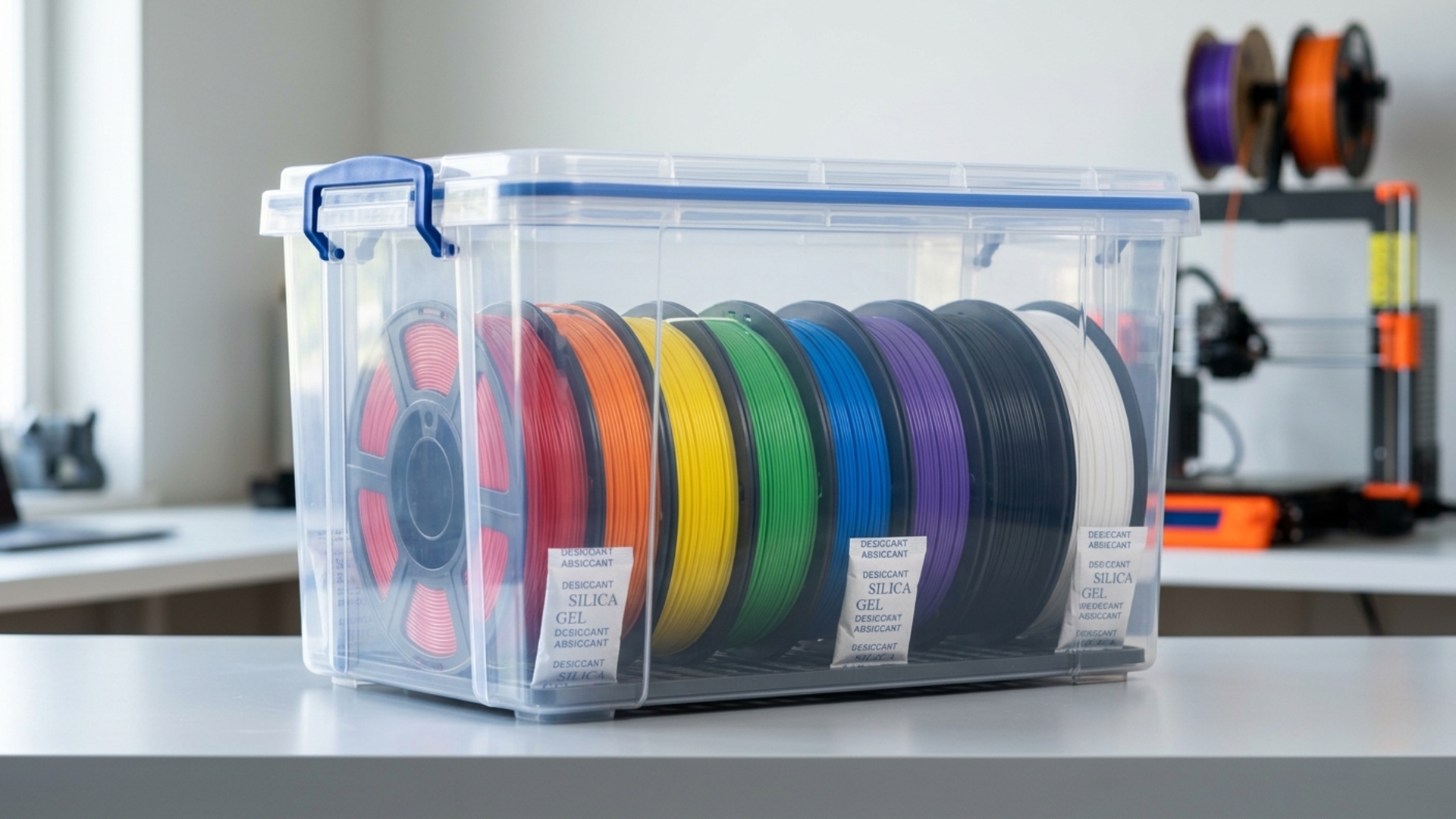
Table of Contents:
- – How to Keep Filament Dry and Prevent Moisture, Dust, and Heat Damage
- – The Use of Desiccants in Filament Storage Processes
- – How to Use and Maintain Desiccants
- – Dust and Heat Prevention in Terms of Sealing and Cleaning Storage
- – Filament Cleaners in Terms of Additional Dust and Contamination Prevention
- – Avoiding Sunlight and Heat Exposure for Storing Filament
- – Filament Storage Checklist, Including How to Check for Moisture in Filaments
- – Filament Storage Checklist in Terms of Re-Drying
- – Quick Reference Storage Checklist for Keeping Your Filament Rolls Dry
How to Keep Filament Dry and Prevent Moisture, Dust, and Heat Damage
Moisture can quickly devastate 3D printing filaments. The most prevalent filaments used for 3D printing, such as PLA, ABS, and PETG, are all highly prone to absorbing water from the atmosphere. As a result, a lot of issues can arise, including a reduced print quality. In fact, it has been established that filament tends to expand when subjected to wet conditions, resulting in a significant increase in thickness and width by approximately 6 and 10 percent, respectively. This causes the produced items to have less weight than the expected ones, thus lowering the density. Reduced print adhesion and tensile strength are also consequences of the expansion process.
The Use of Desiccants in Filament Storage Processes
| Material | Moisture’s Typical Impact on Mechanical Characteristics |
|---|---|
| PLA | Reduced tensile strength ductility in some circumstances improved mechanical characteristics in other research |
| ABS | Reduction in tensile strength modulus enhanced ductility no appreciable effect on ultimate strength |
| PETG | Improved tensile strength was observed with time, together with a slight increase in modulus of elasticity, but a reduction in ductility. |
The ability of ABS to absorb moisture is relatively low. However, even a little amount of moisture might result in undesirable printing outcomes, such as lower print quality and filament expansion. Similarly, nylon has a high affinity for water molecules, which affects its mechanical characteristics, resulting in faulty printing outputs.
Dust Issues with Storage
Dust can be dangerous not only for humans but also for 3D printing filaments. Specifically, when spools of filament are kept in storage, dust accumulates on their surface. When loading the filament into the printer, the dust gets caught inside the hot end’s nozzle. This causes several problems, such as the filament becoming clogged. Additionally, dust on filament might result in poor printing quality, such as the generated prints having a rough surface and inconsistent layer adhesion.
Airtight Containers and Bins, and Their Role in Storing Filament
Airtight containers play a critical role in keeping filaments protected and free from moisture. It is critical to utilize airtight containers for storing filaments in order to avoid damaging them as a result of exposure to dampness and humidity. Cereal boxes or plastic storage bins with tight-fitting lids are excellent options for keeping filament dry and secure. The use of airtight containers for filament storage will considerably reduce the likelihood of filaments becoming wet, which could result in malfunctioning printers. Desiccants are essential in this kind of 3D printing filament storage because they absorb any traces of moisture. As a result, desiccants help to keep filaments dry and free from the detrimental effects of moisture.
Airtight containers should always be closed to prevent exposure to moisture when not in use. It’s a good idea to keep an eye on the level of humidity inside the filaments storage boxes or airtight containers. Ideally, the humidity level inside the box should be less than 20 percent. A hygrometer can assist in determining the amount of dampness in the filament storage box or airtight containers. It’s crucial to keep filaments in airtight boxes or containers to keep them free from dust and other contaminants. Maintaining clean storage areas and containers might also assist in ensuring that filaments do not get harmed in any way throughout the storage process.
Tip: It is recommended to keep all the filament spools in a dry, cool, and dark environment.
Vacuum Bags, and Other Options for Keeping Filaments Moisture-Free
Vacuum bags are an excellent option for keeping filaments dry and free from moisture. The fact that they exclude oxygen from the filament storage area is what makes vacuum bags so effective. As a result, the amount of moisture in the storage area is reduced, which helps prevent filaments from getting wet. To keep filaments free from the negative effects of moisture, it’s a good idea to use desiccants in conjunction with vacuum bags. Furthermore, vacuum bags may be used for both short- and long-term filament storage. They’re perfect for storing filaments that are particularly sensitive to wetness and humidity.
In comparison to vacuum bags, resealable bags allow for less control over the environment in which the filaments are stored. Additionally, because resealable bags do not eliminate oxygen from the storage area, there is a higher likelihood of filaments being subjected to dampness and humidity. On the other hand, vacuum-sealed bags are a fantastic choice for keeping filaments free from the damaging effects of moisture. The amount of air contained within a vacuum bag is split in half, with the amount of water content being halved as well. Consequently, the filament’s likelihood of becoming wet is significantly decreased. To attain the best results when using vacuum bags for filament storage, it’s a good idea to use desiccants.
Moisture, Dust, and Heat Protection in Terms of Original Packaging
The majority of spools of filament come with vacuum-sealed bags as part of their original packaging. As a result, keeping the filament in its original packaging is an excellent strategy to keep it safe and free from moisture and dust. When the filament is not in use, it’s a good idea to leave it in the original bag since it has already been treated to be safe from the damaging effects of moisture. Whenever feasible, it’s a good idea to keep the filament in the vacuum-sealed bag with desiccants. This is the most effective and recommended method for keeping filaments dry, dust-free, and safe from the damaging effects of humidity. The proper filament storage method will ensure that filaments are kept in excellent condition for an extended period of time. The following advice should be followed when it comes to filament storage:
– It is critical to keep the unused filament in its original packaging.
– When the filament is not being used, it should always be stored in its original vacuum-sealed bag with desiccants.
– Avoid leaving the filament exposed until it’s time to use it.
– Keeping the filament rolls in their original packaging is the most effective and recommended approach to storing filament for 3D printing.
Storage Cabinets and Boxes, Including Dry Boxes, for Controlling Humidity in the Storage Area
Filament storage cabinets and boxes are also excellent options for keeping filaments free from the damaging effects of moisture. These boxes have the ability to regulate humidity levels, which is critical when it comes to filament storage. A number of filament storage cabinets are available, each of which can provide varying degrees of control over the amount of humidity in the storage area containing the filaments. Below is a table that compares the relative humidity levels of various storage cabinets.
| Storage Cabinet | Relative Humidity Level Achieved |
|---|---|
| Desiccant and nitrogen dry cabinets | <5% RH (<1% RH for many) |
| Dr. Storage XC Series | 35-45% RH (For cameras and optics) |
| XC Series dry cabinets | <5% RH (Achieved in under 30 minutes) |
| F1 Series dry cabinets | <1% RH (Achieved in under an hour) |
| A3DP Filament Drying Cabinet | <1% RH (Humidity range: 1-20% RH) |
The floor life clock is stopped for components subjected to less than 8 hours of exposure by storing them at less than 10 percent RH. For filaments and components subjected to higher humidity or longer exposure, storage at less than 5% RH is advised in many cases. In less than 30 minutes, the XC Series dry cabinets may attain relative humidity levels of less than 5%. In less than an hour, F1 Series dry cabinets may attain lower than 1 percent RH.
Note: It’s a good idea to keep the RH level in the filament storage cabinet below 45%. The filament storage process might be hampered by higher than 55-60 percent relative humidity.
Storage cabinets and boxes are fantastic options for keeping filaments dry, free from dust and other contaminants. Moreover, they provide the ability to regulate the amount of humidity in the storage space for the filaments. As a result, storage cabinets and boxes are excellent filament storage solutions that should be utilized in order to attain the best possible filament storage results.
The Use of Desiccants in Filament Storage Processes
Filaments may be kept free from the damaging effects of moisture by using desiccants. Desiccant packs are widely utilized in 3D printing filament storage since they help to maintain low levels of humidity in the storage environment. There are several types of desiccant packs that may be utilized for filament storage purposes. Silica gel packs are the most often utilized desiccant packs for this type of filament storage. Silica gel packs typically have the ability to absorb moderate levels of humidity. They may also be utilized more than once because they may be dried after being exposed to moisture. Molecular sieves, on the other hand, have the ability to absorb much more moisture than silica gel packs. Molecular sieve desiccants packs may also be used more than once. Calcium chloride, on the other hand, is more powerful than silica gel but less useful than molecular sieves. They are also a cost-effective choice compared to silica gel packs, although they are not as effective as molecular sieves.
| Desiccant | Moisture-Absorbing Capacity | Reusability | Cost Comparison |
|---|---|---|---|
| Calcium Chloride | Better than Silica Gel | Not recommended | Much cheaper than Silica Gel |
| Silica Gel | Moderate | Recommended | Moderate |
| Molecular Sieves | Much better than Silica Gel | Recommended | Much more expensive |
Silica gel packs, which are the most prevalent type of desiccant packs, are simple to utilize in filament storage and provide moderate humidity-absorbing capacity. Molecular sieves, on the other hand, have a much higher humidity-absorbing capacity, making them appropriate for sensitive filaments. Calcium chloride has a much greater ability to absorb humidity than silica gel and is an excellent option for short-term filament storage. Using desiccant packs for filament storage comes with a number of advantages and considerations.
How to Use and Maintain Desiccants
The use of desiccant packs will help to keep filaments free from the damaging effects of moisture. Using desiccants in conjunction with filament storage boxes and airtight containers might assist in maintaining the ideal level of humidity throughout the storage process for filaments. When it comes to desiccant packs for filament storage boxes, silica gel packs are the most often utilized. Silica gel packs have a hygroscopic nature, allowing them to absorb moisture from the atmosphere. They also have an indicator that allows you to determine whether the desiccant pack has been utilized. A digital hygrometer is the most accurate technique for measuring the amount of humidity in a given location. When it comes to humidity, anything less than 20 percent is considered to be a suitable amount. When it comes to desiccant packs used in filament storage, they should always be replaced when they have reached their maximum capacity. When it comes to silica gel packs, they should be dried in an oven and then reused when the opportunity arises. One of the most cost-effective ways to maintain filaments in excellent condition while avoiding the damaging effects of humidity is to use desiccant packs in filament storage boxes. As a consequence, it’s essential to use desiccant packs in filament storage boxes to keep filaments in good condition.
Tip: It is crucial to pay close attention to desiccant packs and relative humidity levels when it comes to keeping filaments in good condition.
Dust and Heat Prevention in Terms of Sealing and Cleaning Storage
When it comes to filament storage, sealing storage boxes, bags, and other filament storage equipment is critical. When filaments are stored, it’s crucial to ensure that they’re placed in a clean environment free from the damaging effects of dust. Sealing the storage boxes after removing or placing the filaments inside is an excellent way to ensure that they’re free from the damaging effects of dust. Keeping the filament storage area clean is also crucial for keeping filaments safe and free from the damaging effects of dust.
- Wet cloths may be used to wipe storage boxes clean.
- When the cleaning needs something extra, a small quantity of mild soap and water would do the trick.
- It’s crucial to make sure the boxes are clean and dry before storing the filaments inside them.
- Vinegar and water may be utilized to get rid of grime from the storage boxes and bags used for filament storage.
- Cornstarch may also be used as a cleaning and polishing agent by mixing it with liquid cleaner to create a thick paste.
- Baking soda, when combined with water, might be used to eliminate unpleasant odors and clean the storage boxes and bags used for filament storage.
As a result, a clean storage area will help keep filaments free from the damaging effects of dust.
Filament Cleaners in Terms of Additional Dust and Contamination Prevention
Filament cleaners are an excellent option for eliminating dust from filament spools. Filament cleaners assist in preventing dust and other foreign objects from getting caught in the printer’s hot end, causing clogs and other issues. Below is a filament cleaners comparison that highlights the essential characteristics of filament cleaners.
| Dust-Removing Sponge’s Attributes |
|---|
| Dust-removing sponge cleans filament spools of dust, decreasing the likelihood of clogs or jams in the filament extrusion system |
| Lightweight sponge, simple to grasp |
| Dust and bits of trash are captured by the filament cleaner |
Using a filament cleaner helps to ensure that the extrusion system receives a steady supply of clean filament. Additionally, it may aid in prolonging the lifetime of the filament extrusion system, including the hot end and nozzle. As a result, filament cleaners are extremely useful, particularly in filament storage, where they help to reduce the likelihood of dust causing printing faults. It’s essential to use a filament cleaner to prevent the extrusion system from becoming clogged or jammed as a result of dust and other contaminants present on the filament.
Avoiding Sunlight and Heat Exposure for Storing Filament
Exposure to sunlight and heat might have a significant influence on the filament storage process. Sunlight might seriously weaken the molecular structure of the filaments, resulting in brittle filaments that are challenging to print with. Additionally, the filaments’ tendency to acquire discoloration increases as a result of their exposure to high temperatures. For many filaments, including PLA and regular ABS, high temperatures cause them to lose their flexibility under strain and eventually fracture. When it comes to 3D printing, it’s critical to keep filaments out of direct sunlight. Ideally, the filaments should be stored in a cool and shady area since the recommended temperature for filament storage is twenty to twenty-five degrees Celsius. As a result, filaments should never be stored in hot conditions since they might quickly become damaged.
Tip: When it comes to filament storage, always keep the filaments out of direct sunlight and keep them in a cool location.
Filament Storage Checklist, Including How to Check for Moisture in Filaments
Inspection and monitoring of the filament storage process will help to ensure that filaments are kept in excellent condition for a prolonged period of time. The following filament storage checklist should be utilized when filament storage is in progress or when verifying the filament storage conditions:
- Filaments tend to exhibit signs of dampness as a result of improper filament storage processes.
Filament Storage Checklist
- Rough spots or bumps on the produced prints
- Thin strands of plastic that link together various components after the print has finished
- Blisters or bubbles that might develop during the printing procedure
- Snapping or crackling sounds coming from the filament nozzle during printing.
- Prints that peel away from each other effortlessly
- Weighing the filament spools before and after the drying process to ensure that they have not lost weight as a result of the drying process
- Using a simple hygrometer inside the storage box or storage bin helps determine whether there is too much moisture in the box or bin.
When using a filament storage box and/or containers, inspect the finished prints visually for indications of printing flaws. If there are any printing problems, double-check the filament’s condition and the filament storage procedure in general.
It’s critical to check regularly for the signs listed above in order to detect filament storage problems in the early stages. As a result, filament storage issues may be resolved swiftly and efficiently.
Filament Storage Checklist in Terms of Re-Drying
If filaments have absorbed moisture, they must be dried again to restore their initial characteristics. There are several ways for accomplishing this, including using a food dehydrator to dry the filaments. Using a food dehydrator is an excellent alternative for the usual PLA, PETG, and ABS filaments. Vacuum drying is also an option, although thermal drying is a more effective choice. Another alternative is to use an oven, which is an appropriate method of filament drying when a dehydrator is not available. The following filament storage checklist should be followed when re-drying filaments.
Tips for Re-drying Filaments
| Filament | Drying Method/Time |
|---|---|
| Filament dryer/oven | Dry filament for 4-6 hours |
| PETG Drying | Drying for at least 3 hours |
The utilization of airtight containers with desiccants will assist in maintaining the filaments dry throughout the re-drying procedure. The filament storage process has a considerable impact on the quality of 3D printing results, thus it should be monitored with care.
Quick Reference Storage Checklist for Keeping Your Filament Rolls Dry
Keeping your storage area free from the damaging effects of dust and moisture will aid in achieving excellent printing results while keeping filaments in good condition for a much longer period of time. To ensure proper filament storage, the following filament storage checklist should be performed regularly:
- Keeping spools of filament in ziplock bags with desiccants helps keep them dry.
- Storing multiple filament spools in a plastic storage box with a tight-fitting lid along with desiccants is recommended.
- Consider using a dry box for sensitive filaments to help keep them stable.
As a result, the regular maintenance of filament storage will assist in preventing filaments from being subjected to the damaging effects of moisture, resulting in brittle filaments with a high likelihood of breaking during printing. For additional guidance on filament storage, printing preparation, or choosing an appropriate Plastic 3D Printing Service In Malaysia, contact our team. A suitable 3D Printing Company In Malaysia can also help you select the right printing process and material for your project, while a Metal 3D Printing Service Malaysia may be considered when the application requires metal components.
- Tagged: 3D Printing Company In Malaysia, 3D Printing Creations Malaysia, 3D Printing Designs Malaysia, 3D Printing for Product Development, 3D Printing Malaysia, 3D Printing Service Costs, 3D Printing Service Malaysia, 3D Printing Service Online, 3D Printing Services Online, Ceramic 3D Printing Service, Metal 3D Printing Company in Malaysia, Metal 3D Printing Malaysia, Metal 3D Printing Service In Malaysia, Metal 3D Printing Service Malaysia, Plastic 3D Printing, Plastic 3D Printing Service In Malaysia