
Six Ways to 3D Print Aluminum Covering Every Budget & Application
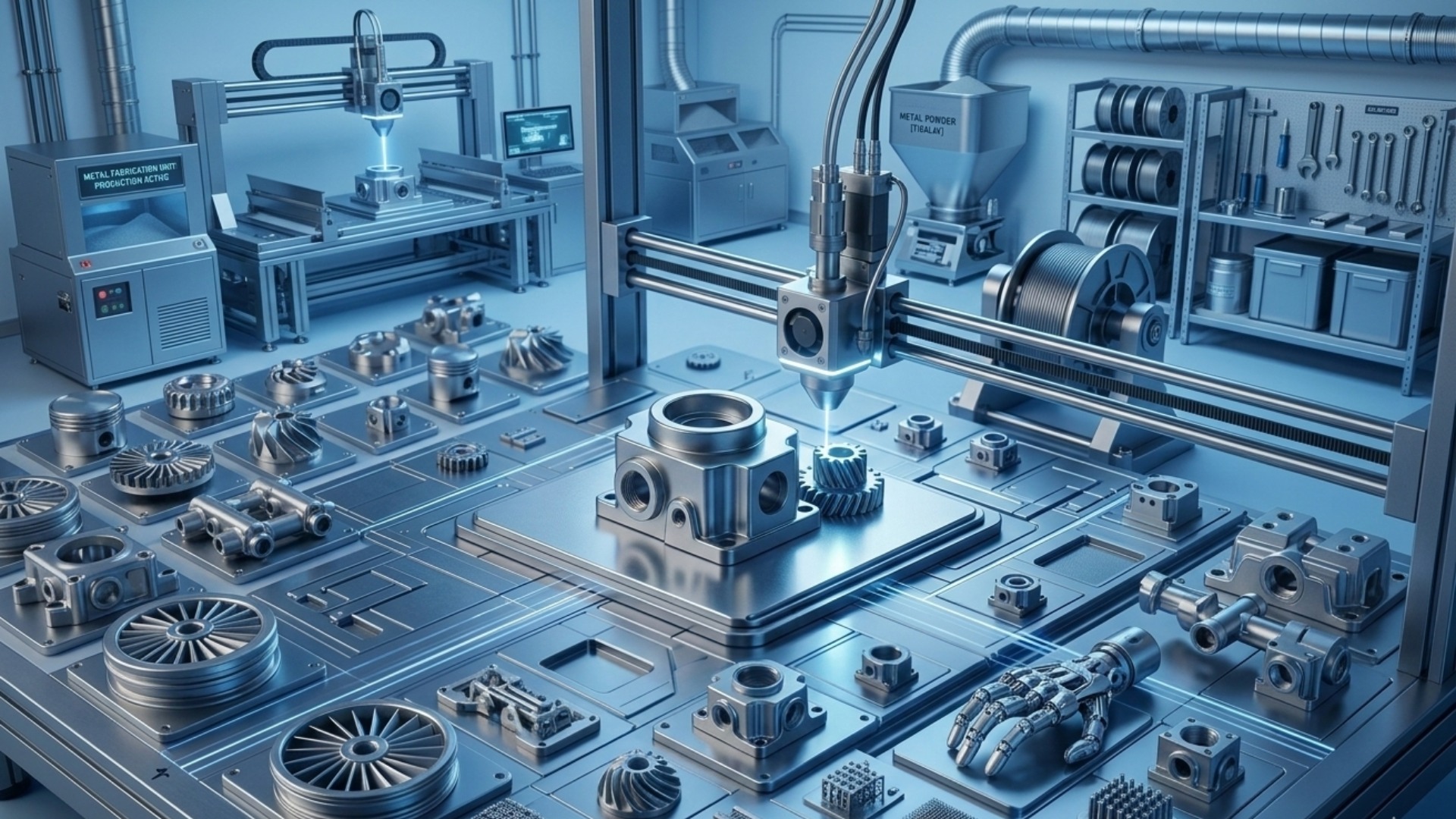
The Most Accessible Aluminum 3D Printing or the Most Potent Industrial Solutions, Which Is the Best for You?
Table of Contents:
-
-
- Method 1: The Budget Option, Desktop 3D Printing
- Method 2: Laser Powder Bed Fusion (LPBF) – The All-Rounder
- Method 3: Molten Directed Energy Deposition (Molten DED)
- Method 4: Cold Spray – The High-Speed Solution
- Method 5: Wire Arc Additive Manufacturing – The Large-Scale Solution
- Method 6: Order Aluminum 3D Printed Parts – The Practical Solution
-
Once the exclusive domain of aerospace giants and Formula 1 teams, 3D Printing Aluminum parts is now more accessible than ever. Today, Aluminum 3D Printing in Malaysia is becoming increasingly available through specialized providers. However, with new technologies come new questions: Which method is right for your project and your budget? In this guide, we break down the five primary ways to create aluminum parts, from methods accessible through online services costing only a few hundred dollars to industrial machines capable of building rocket components. Whether you work with a 3D Printing Company in Malaysia or look for a 3D Printing Service Near Me, understanding the technology and cost will help you make the right choice.
So, Why Aluminum?
Method 1: The Budget Option, Desktop 3D Printing
There are still few choices for producing functional aluminum parts and inexpensive in-house prototyping. Aluminum filaments are much less prevalent, even though desktop FDM printers may use metal filament to create solid stainless-steel pieces.
At the moment, only one manufacturer provides a real aluminum metal filament that is intended to be used in the production of metal parts following a debinding and sintering procedure that extracts the polymer from the metal powder. Aluminum 6061 Filamet is a polymer strand that comprises around 67% aluminum powder. Parts can reach a metal density of around 93% after sintering at high enough temperatures and times, but they usually shrink by about 20%.
The majority of desktop FDM printers that can achieve the necessary temperature settings (nozzle temperature: 190–230°C; bed temperature: 40–65°C) can print this filament.
One of the primary disadvantages of metal filament printing is part shrinking, which is rather predictable. Strength and wear resistance are examples of mechanical qualities that are typically poorly reported.
Other filaments that are sold as aluminum usually merely refer to their appearance or have a 20%–35% aluminum powder content. These materials don’t require debinding or sintering, yet they can be polished to look like aluminum and weigh similarly.
Carbon-fiber-filled nylon is frequently a preferable option for those looking for a desktop FDM printer with strength comparable to aluminum.Desktop printers are also commonly used for Scale Model 3D Printing and prototype development before producing final aluminum parts.
Method 2: Laser Powder Bed Fusion (LPBF) – The All-Rounder
The most popular method for 3D printing aluminum is laser powder bed fusion (LPBF), sometimes referred to as selective laser melting (SLM). High-powered lasers are used by LPBF printers to selectively melt metal powder. Until the final sculpture is finished, the melted layers fuse together at the molecular level.Aluminum cannot be processed by all printers that use this technology. To manage porosity, microstructure, and final material qualities, printing parameters must be carefully tuned based on the characteristics of the aluminum alloy being utilized. For this reason, printer manufacturers and material suppliers frequently collaborate closely.Top Aluminum LPBF Uses
LPBF excels at producing complex, detailed, and high-performance components that cannot be manufactured using traditional methods. For aluminum, this has enabled a new generation of optimized parts such as heat exchangers.
Because of its lightweighting capabilities and design flexibility, LPBF is ideal for aircraft brackets, satellite antenna supports, suspension components, and lightweight robotic structures.
In automotive applications, LPBF has been used for custom pistons with internal cooling channels, lightweight brake calipers, optimized intake manifolds, and functional engine prototypes.
Method 3: Molten Directed Energy Deposition (Molten DED)
In order to create or repair parts, directed energy deposition (DED) melts wire or metal powder during the deposition process. This technology works especially well with aluminum. Methods 4 and 5 can also be categorized as DED technologies, however in this case, molten DED—also known as liquid metal jetting—is the main focus.
Only a few manufacturers presently offer molten DED, which is a relatively new product. Heat is used in the process to melt and deposit metal—typically aluminum—layer by layer onto a construction surface.
This method has the benefit of not requiring toxic metal powders, and completed parts often don’t require any more post-processing beyond machining or polishing. Standard welding wire is usually used as the feedstock, which removes the requirement for pricey powders.
Although items can be machined later to obtain tighter tolerances, molten DED does not generate the same interior features or fine details as LPBF.
A comparable method minimizes tensions in the material and uses less energy by making the metal sufficiently pliable for deposition without melting it. This technique can process a variety of metal alloys without the need for sealed chambers or protective gasses.
Top Aluminum Molten DED Uses
Usually, near-net-shaped components that are subsequently machined are created using molten DED. It is especially useful for large-scale prototypes that require testing of shape, fit, and fundamental functionality.
In general, large components, quick production, repairs, or hybrid manufacturing are more suited for molten aluminum DED than small, intricate parts.
Method 4: Cold Spray – The High-Speed Solution
The fastest additive manufacturing technique for creating aluminum components is probably cold spray. This method involves layer-by-layer deposition of aluminum powder onto a construction surface as it is accelerated at supersonic speeds. Heat treatment or other post-processing is not necessary because the particles connect by kinetic energy rather than melting.Top Aluminum Cold Spray Uses
Cold spray is very helpful in military, mining, and emergency repair scenarios due to its speed from design to working item, even if final machining is frequently necessary.
Method 5: Wire Arc Additive Manufacturing – The Large-Scale Solution
Large aluminum parts can be produced rapidly using Wire Arc Additive Manufacturing (WAAM), which is usually followed by machining to attain exact tolerances. Originally called form welding, this technique has long been employed in heavy industry and aircraft.
These days, forging, casting, or machining large metal components is thought to be more expensive and time-consuming than using WAAM. It also aids in cutting down on production time and material waste.
Similar to welding, WAAM uses an electric arc as the energy source and metal wire as the feedstock. A robotic arm melts the wire and deposits it layer by layer onto a construction surface. To manage material characteristics and stop oxidation, an inert gas is utilized.
Top Aluminum WAAM Uses
It is very costly and wasteful to machine solid aluminum blocks into meter-scale aerospace parts. WAAM saves a lot of material and production time by producing near-net-shape parts.Large molds, jigs, and fixtures required in assembly are also made with WAAM.
Method 6: Order Aluminum 3D Printed Parts – The Practical Solution
Purchasing aluminum parts from qualified service providers is frequently the most sensible choice if none of the aforementioned approaches meet your manufacturing schedule or budget.
An increasing number of businesses provide aluminum additive manufacturing for custom designs, replacement parts, functional components, and prototypes. For local production and assistance, many clients select a Malaysian 3D printing company.
Although some provide other procedures, service providers generally employ laser powder bed fusion technology. It’s crucial to take finishing options like polished or brushed surfaces into account when acquiring parts.
If you’re searching for dependable and superior 3D printing services, get in contact. Whether you require prototypes, functional parts, or unique designs, our staff is prepared to help your project from the very beginning to the very end.
Get in touch to find out more about our expertise and how we can provide reliable, workable solutions to help realize your ideas.