
3D Printing For Medical Education
3D printing (also called additive manufacturing) is a process which takes place with the help of a special printer. In this technology, objects are created by layers of print-ready material. 3D Printing in Education has a wide range of applications in the medical education field. The process starts with designing, where specialized designers are using CAD (Computer-Aided Design) software to create the desired design. After that, the designed model is printed using a 3D printer and special materials. One of the main advantages of 3D printing is that it allows the creation of complex structures and customization as needed. Objects such as anatomical teaching models, surgical simulators, prostheses, and even tissues may be printed with the help of this technology.
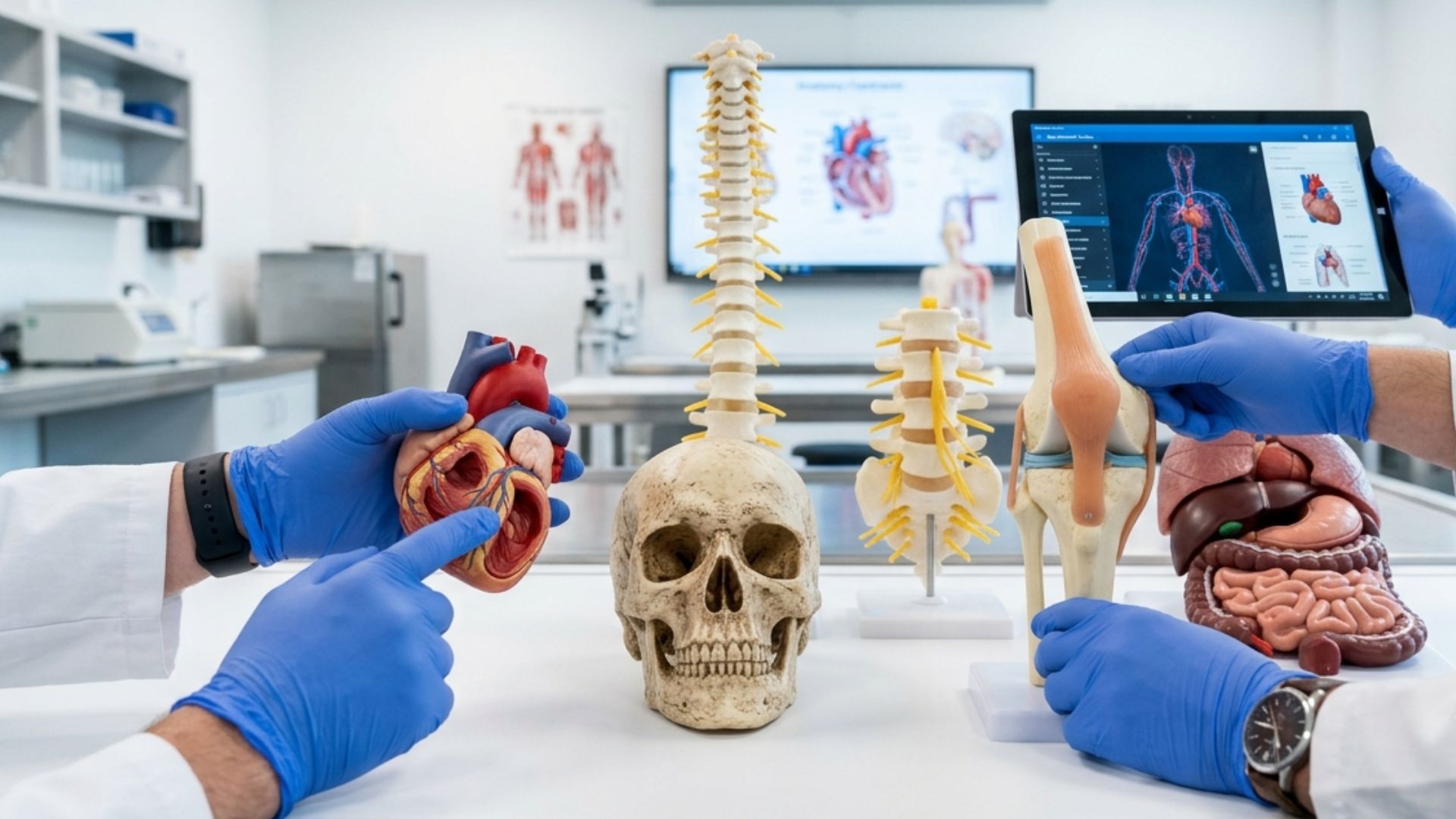
Table of Contents:
- Historical Development of 3D Printing Applications in the Field of Medical Education
- Benefits of 3D Printing in Modern Medical Education Applications
- Challenges and Solutions for 3D Printing in Medical Education
- Tools and Technologies for 3D Printing in Medical Education
- Future Trends in 3D Printing for Medical Education
- Examples of 3D Printing in Medical Education
- Steps to Implement 3D Printing in Medical Education
- FAQs About 3D Printing for Medical Education
Historical Development of 3D Printing Applications in the Field of Medical Education
In the 1980s and 1990s, additive technology started to develop. Initially, 3D printing was used to create prototypes of medical devices. Later, the technology made significant progress, allowing researchers to print anatomical structures using this technology. At the beginning of the 21st century, 3D printing was used to create personalized anatomical models for surgery planning. Currently, 3D Printing Service Malaysia providers and educational institutions successfully utilize this technology in the field of medical education.
Benefits of 3D Printing in Modern Medical Education Applications
Industry-Specific Advantages
There are a lot of benefits of 3D printing in modern medical education applications. Some of them are the following:
Advancing medical education: The use of 3D printing allows the creation of realistic teaching anatomical models, thus helping students better understand the complex structure and functions of the human body.
Supporting the development of surgical skills: This technology allows medical workers to train on real-life simulations, helping them gain valuable experience and reduce the possibility of medical errors.
Enabling the personalization of medical education: 3D printing allows the creation of individualized anatomical models for each student. This is especially important for students studying rare diseases or disorders.
Reducing costs and increasing accessibility: 3D Printing Service In Malaysia is often less expensive than conventional methods. In addition, additive manufacturing enables educational facilities, even those with limited budgets, to create realistic anatomical models.
Other Benefits of 3D Printing in Education
Aside from industry-specific benefits, there are other advantages of 3D printing in education. These include:
Eco-friendliness: 3D printing uses less material than conventional methods. Objects are created only with the required material, reducing waste.
Sustainability: Since 3D printing requires fewer raw materials and is less material-intensive, it can be considered a more sustainable manufacturing method.
Use of specialized materials: In education, 3D printing allows the use of specialized materials such as biodegradable plastics and sustainable polymers.
Challenges and Solutions for 3D Printing in Medical Education
The Main Challenges
Today, 3D printing in medical education is experiencing rapid growth and has many applications. However, it still faces several challenges:
Cost-competitiveness: The costs of 3D printing may be relatively high because the technology requires specialized equipment and materials.
The need for specialized knowledge: The use of 3D printing requires appropriate skills and technical expertise.
Limited scope: There are certain limitations regarding the materials that can be used in this technology.
Regulatory issues: Medical education is characterized by strict regulations, and the use of 3D printing often faces legal and regulatory challenges.
Solutions
Possible solutions include:
Developing collaborative partnerships: Educational institutions may establish partnerships with a 3D Printing Company In Malaysia to address issues such as limited resources and high implementation costs.
Providing training and education: Medical professionals and students should receive the knowledge and practical skills necessary to apply 3D printing technology effectively.
Developing new materials and technologies: Continued investment in research and development can help overcome current material limitations.
Establishing clear regulatory guidelines: Clarifying regulations can reduce legal uncertainties and encourage wider adoption.
Tools and Technologies for 3D Printing in Medical Education
Software
Various software solutions are used in 3D printing, including:
Computer-Aided Design (CAD): CAD software helps create designs for printing. Examples include AutoCAD and SolidWorks.
Simulation software: This software is used to create anatomical and surgical simulators. Mimics is one example.
Slicing software: Slicing software prepares digital models for 3D printing. Popular examples include Cura and Simplify3D.
Hardware
Several hardware technologies are also used in 3D printing:
3D printers: These printers create objects layer by layer and are used to manufacture anatomical models, prostheses, surgical simulators, and other medical devices.
Bioprinters: Bioprinters are used to print living cells, tissues, and organs. The technology continues to evolve, making increasingly complex biological structures possible.
Portable and affordable printers: Modern 3D printers are significantly more affordable than they were several years ago, allowing more educational institutions to adopt the technology and produce 3D Printing Products Malaysia for teaching purposes.
Future Trends in 3D Printing for Medical Education
Emerging Technologies
Several emerging technologies are expected to enhance medical education:
Artificial Intelligence (AI): AI has many applications in medicine and education, helping students better understand complex concepts through intelligent learning tools.
Nanotechnology: Nano-scale 3D printing may enable the production of highly detailed medical devices and structures.
Advancements in bioprinting: While bioprinting currently focuses on simple tissues and cells, future developments may enable the production of more complex tissues and organs.
The Future of 3D Printing in Medical Education
The future of 3D printing in medical education offers numerous opportunities. Experts predict continued growth in the adoption of additive manufacturing worldwide, leading to greater international collaboration in medical education. Technologies such as virtual reality and 3D printing will increasingly be combined to create realistic surgical simulators, improving both learning outcomes and practical training experiences.
Examples of 3D Printing in Medical Education
Example 1: Anatomical Models
Medical education facilities are using 3D printing to create anatomical models. These models allow students to better understand the structure and function of the human body.
Example 2: Creating Surgical Simulators
3D printing is also used to create surgical simulators, enabling medical professionals to strengthen their practical skills through realistic training.
Example 3: Creating Anatomical Models Using Patient MRI Scans
3D printing can also produce anatomical models based on patient MRI scans, allowing doctors to prepare more effectively for surgeries.
Steps to Implement 3D Printing in Medical Education
Steps
After understanding what 3D printing is, its benefits, and its applications, institutions can implement the technology through the following steps:
Define the objective: Identify educational needs, such as creating anatomical teaching models or surgical simulators.
Choose the tools: Select the appropriate software and hardware based on the intended application.
Train students and faculty: Provide comprehensive training to ensure effective use of the selected tools.
Print the first models: Begin producing educational models that help students improve their knowledge and practical skills.
Analyze and optimize the implementation process: Evaluate the results and identify opportunities for continuous improvement.
Do’s and Don’ts of Implementing 3D Printing in Medical Education
Do’s
1.Invest in a high-quality 3D printing system.
2.Provide appropriate training for students and teachers.
3.Establish partnerships with experts in the field.
4.Update tools and software regularly.
5.Apply 3D printing to personalize learning experiences.
Don’ts
1.Use low-quality equipment.
2.Ignore the importance of training.
3.Work without professional support.
4.Neglect continuous optimization.
5.Use generic models for complex medical cases.
FAQs About 3D Printing for Medical Education
1.What is 3D printing for medical education?
3D printing for medical education is the use of additive manufacturing to produce anatomical teaching models and other educational tools that improve learning experiences.
2.How does 3D printing affect different industries?
3D printing is widely used across healthcare, construction, aerospace, automotive, and many other industries. Within medical education, it enables the creation of anatomical models, surgical simulators, prostheses, tissues, and organs. In other industries, it supports rapid prototyping, spare part production, and customized manufacturing.
3.What are the costs associated with 3D printing for medical education?
The costs depend on the scale of implementation. Small-scale educational applications, such as printing anatomical models, generally cost much less than large-scale medical applications in hospitals.
4.What are the best 3D printing tools for medical education?
Popular tools include CAD software such as AutoCAD and professional 3D printers from manufacturers such as Formlabs and Stratasys.
5.How can I get started with using 3D printing in education?
To begin using 3D printing for educational purposes, first identify your objectives and choose the appropriate tools. It is also essential to invest in training and collaborate with experienced providers. If you are looking for reliable 3D Printing Service In Malaysia, get in touch with our team to explore how our expertise can help implement innovative 3D printing solutions for medical education.