
Reverse Engineering With 3D Scanning: A Complete Scan To CAD Guide
Reverse engineering is the vital process in the automobile, engineering machinery, heavy industry field. It enables manufacturers and researchers to replicate and modify an existing design for a product or component. Compared to traditional reverse engineering approaches, 3D scanning has the advantages of being quick and accurate, as well as digitize all the features of the object during the scan to CAD workflow. Businesses that need reliable 3D Scanning Services can use this technology to capture physical components and convert them into usable digital data.
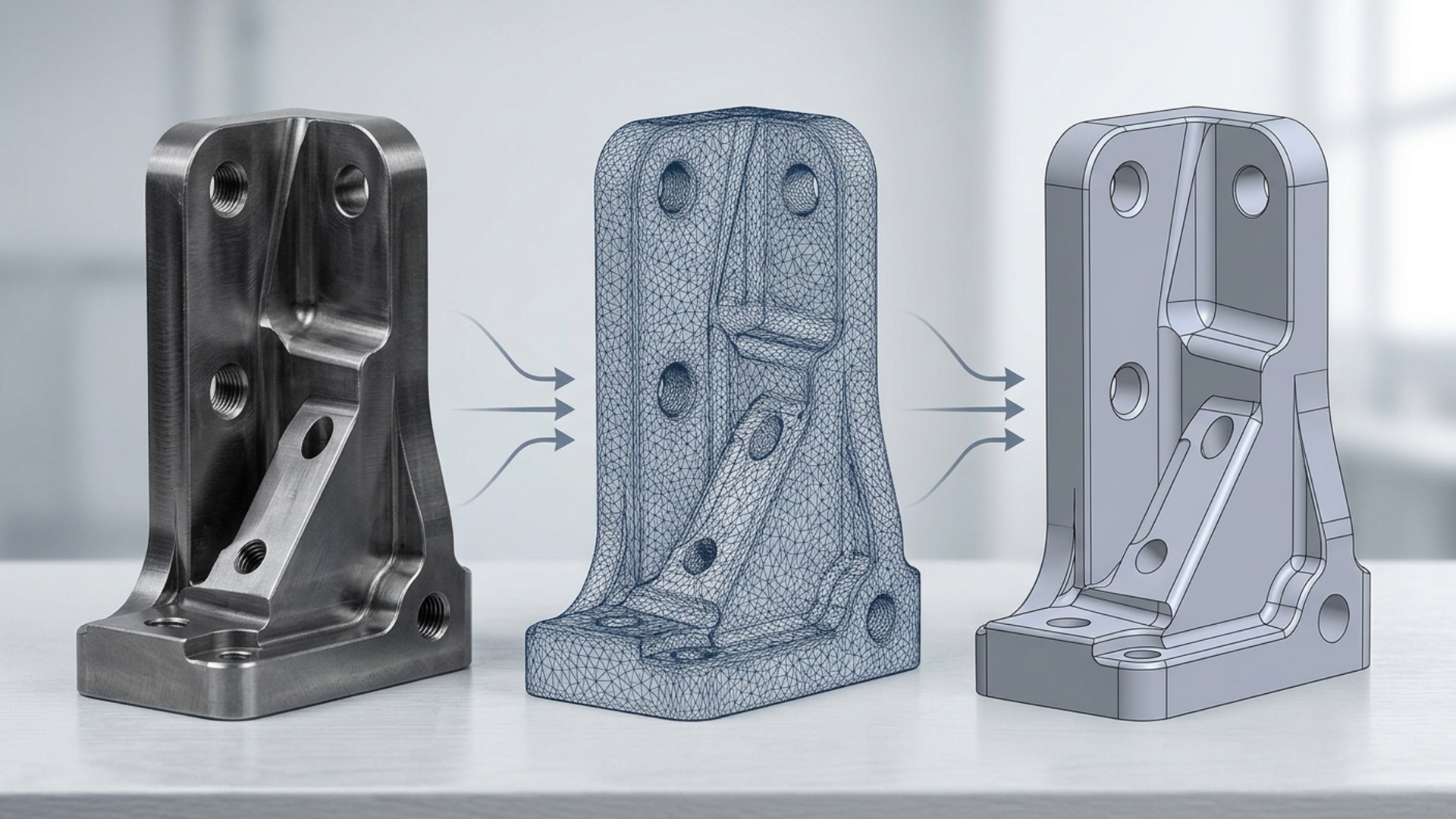
Table of Contents:
In this article, we will introduce how 3D scanning technology revolutionizes the process of reverse engineering, the best options for reverse engineering from scan to CAD, and the application fields of 3D scanning for reverse engineering.
1. Reverse Engineering Definition
Reverse engineering (also called back engineering) refers to a research or manufacturing method in which the design information of a certain product or component is extracted by analyzing and studying an existing product to understand its function and structure. It is typically used for the purpose of optimizing designs by analyzing competitors’ products, replicating obsolete parts, repairing broken machinery, or modifying parts.
However, design information extraction can be challenging, especially if you are using the manual approaches.
2. Manual Reverse Engineering vs. 3D Scanning for Reverse Engineering
Traditional reverse engineering often involves manual measurements using an array of tools, such as calipers, CMM, etc. Though effective on some simple geometries, it is often challenging since reverse engineering methods are not adaptive to complex shapes. Some of the limitations are listed below:
– Low Efficiency
It is very time-consuming to manually measure the target object especially for complicated geometries.
– Inaccuracy
Manual approaches often result in low precision, especially when the target object cannot be accessed fully during the measurement process.
– Not Easy to Adapt to Complex Structures
Manual measurements and digitizing approaches have limited ability to capture freeform, organic surfaces or difficult-to-access locations.
3D scanning technology, on the other hand, provides much better solutions to all these challenges. For example, 3D scanners can capture all the geometric features of the target object digitally without damaging it. Whether it is used for simple or complex geometries and even for hard-to-reach areas, scanners offer a much better scanning experience and accuracy during the scan to CAD process. As a result, the reverse engineering workflow incorporating 3D scanners is much more efficient and reliable, making it applicable in many fields such as reverse engineering for manufacturing and product development.
Let’s dive into details on how reverse engineering using 3D scanning works.
3. How to do Reverse Engineering with 3D Scanning?
The following steps demonstrate the entire reverse engineering process with 3D scanning:
Step 1: Scanning the object of interest
The first step is to obtain a digital representation of the target object using the 3D scanner. With EinScan Lite, it only takes minutes to finish scanning the target object.
Step 2: Generate a high-quality mesh model
Using the powerful onboard NVIDIA processor, the scanned point cloud data is converted to a clean mesh (STL file). Mesh cleaning is performed directly on the device via a 5.5-inch LCD screen. Users can clean, edit, and optimize the mesh model as needed.
Step 3: Convert mesh model to CAD model
The mesh model can be converted into an editable CAD model with just one click, completing the scan to CAD workflow for reverse engineering and product design.
Step 4: Engineering analysis and manufacturing
– After obtaining the CAD model, engineers can perform various tasks, including:
– Editing design dimensions
– Conducting CAE analysis
– Saving CAD files for downstream manufacturing such as CNC machining, injection molding, and 3D printed diorama
4. Application Fields of 3D Scanning for Reverse Engineering
The automotive industry has diverse applications and requirements for 3D scanning for reverse engineering. For example, using 3D scanning and reverse engineering, automotive companies can achieve rapid redesign, optimization, and replication of parts, as well as facilitate design improvement, aftermarket customization, and benchmarking of competitors’ products.
With reverse engineering using 3D scanning, auto manufacturers can digitize existing parts to develop improved copies of the original design, or modify certain dimensions or structures as required.
Engineering Machinery and Transportation
In the field of engineering machinery and transportation, such as rail, marine, and construction equipment, there is a great need for reverse engineering to digitize large, complex parts for maintenance, repair, and overhaul (MRO). Using 3D scanning for reverse engineering, machinery manufacturers can reconstruct existing parts for replication, optimize structures to reduce weight or improve performance, and ensure compatibility with existing systems or components, even when original design specifications are unavailable.
By enabling rapid and accurate digitization of large-scale and complicated machinery parts, 3D scanning for reverse engineering facilitates the creation of improved replicas of the original parts.
Enhanced Yacht Customization Enabled by 3D Scanning
Custom Marine Solutions uses wireless 3D scanner to undertake yacht customization. By using the scanner to capture yacht data in outdoor conditions, it is possible to make bespoke carpets and upholstery with greater ease and accuracy.
Repair of Forging Dies
The case study mainly introduces an innovative solution for the repair of forging dies. This solution integrates the 3D scanner with the industrial robot to improve the efficiency and accuracy of die repair.
Power Generation, Heavy Industry, and Public Utilities
For power generation, heavy industry, and public utilities, 3D scanning for reverse engineering facilitates the digitization of critical equipment and infrastructure, such as large-scale turbines, pipelines, and valves. This enables condition assessment and predictive maintenance of infrastructure while supporting retrofits and upgrades to achieve operational and safety standards, as well as reducing downtime.
Through reverse engineering using 3D scanning, power plant operators can capture and analyze the condition of power generation equipment to support maintenance and optimization decisions.
Enabling Mining Equipment Reverse Engineering
Mining equipment parts manufacturer GL Equipamentos was looking for new ways to increase the accuracy and speed of reverse engineering of mining equipment parts. By introducing high-accuracy 3D scanners, they were able to achieve better dimensional control and faster data acquisition in their reverse engineering process.
Electronics and Electrical
In electronics and electrical, reverse engineering using 3D scanning enables the digitization of housing, enclosures, and internal components for the purpose of design iteration, miniaturization, and optimization. It also enables the analysis of fit and function, as well as assessment of thermal performance to accelerate product development and ensure compatibility.
Civil Aviation
In civil aviation, 3D scanning for reverse engineering can be used for inspecting, repairing, and evaluating aircraft parts. This includes determining whether the aircraft parts are deformed beyond specification limits and subsequently reconstructed into a CAD model for further analysis. This enables more efficient maintenance and faster production of aircraft parts, as well as facilitating conformity assessments for aircraft components.
Fast Reverse Engineering for Aircraft Engine MRO
The aircraft MRO company uses the laser scanner to digitize complex non-standard aircraft engine parts, thereby obtaining digital blueprints for fast and accurate repairs.
Medical and Basic Research
In medical and basic research, 3D scanning for reverse engineering can be used to digitize anatomical structures to recreate patient-specific implants, prosthetics, and surgical instruments. Similarly, it enables the analysis and reconstruction of complex research models for the purposes of experimental validation and analysis.
Cultural Creation and Art Customization
With its ability to digitize complex structures with high precision and ease, 3D scanning for reverse engineering has found applicability in cultural creation and art customization. It can be used to obtain digital copies of art or cultural heritage artifacts for modification or reproduction, or to digitize 3D-printed statues for display and customization for commercial purposes.
Preservation and Reconstruction of Oracle Bone Inscriptions
High-precision 3D scanning technology enables the preservation and reconstruction of oracle bone inscriptions by capturing the minute details of the ancient scripts and allowing users to conduct digital rubbings to experience the primitive Chinese civilization.
Research and Education
For research and education, 3D scanning for reverse engineering can be used to instruct students and researchers on the principles of design. By enabling the conversion of physical objects to digital models for analysis and redesign, it helps support innovation and research, as well as build students’ understanding of design principles during their studies. This plays an important role in inspiring and educating the next generation of researchers, engineers, and designers.
Build Dinosaur Models from Fossils
Argentine researchers Dr. Fernando Novas and Prof. Marcelo Pablo Isasi used 3D scanning and printing to digitally recreate the extinct Cretaceous predator called Taurovenator.
5. Benefits of 3D Scanning for Reverse Engineering
With the growing need to develop products and services at a faster rate while maintaining quality, 3D scanning has become an extremely valuable tool for many businesses. By enabling you to obtain highly accurate digital copies of the target object in seconds, it can dramatically improve your reverse engineering workflow. Below are some of the key benefits of using 3D scanning for reverse engineering. For businesses exploring Professional 3D Scanning Services In Malaysia, these benefits can help improve the efficiency of reverse engineering workflows.
Cost-effective: 3D scans offer a cost-effective solution over traditional approaches to reverse engineering.
Superior Accuracy: Thanks to their ability to capture the finest of geometric details, 3D scanners can be used to obtain high-resolution CAD models of complex structures.
Time-saving: Compared to traditional methods, 3D scanning can help you shorten the design and optimization cycle tremendously
For businesses seeking a suitable Malaysia 3D Scanning Service, the right scanning and scan-to-CAD workflow can support accurate and efficient product development.
Conclusion
3D scanning has transformed reverse engineering by making it faster, more accurate, and more adaptable to complex geometries. From automotive components and engineering machinery to medical devices, aviation, and cultural artifacts, the technology provides an efficient way to turn physical objects into digital models for analysis, modification, and manufacturing. If you need help selecting the right scanning workflow for your project, get in reach with out team.