
SLS vs MJF: Choosing The Right 3D Printing Method For Your Product Requirements
This is one of the most common questions in B2B product development, but there is no universal response. It all comes down to your manufacturing goals, component size, material, surface finish, and lead time.
In this article, we will compare two leading powder-bed fusion technologies, Selective Laser Sintering (SLS) and Multi Jet Fusion (MJF), and outline the criteria for choosing between SLS vs MJF 3D printing services .
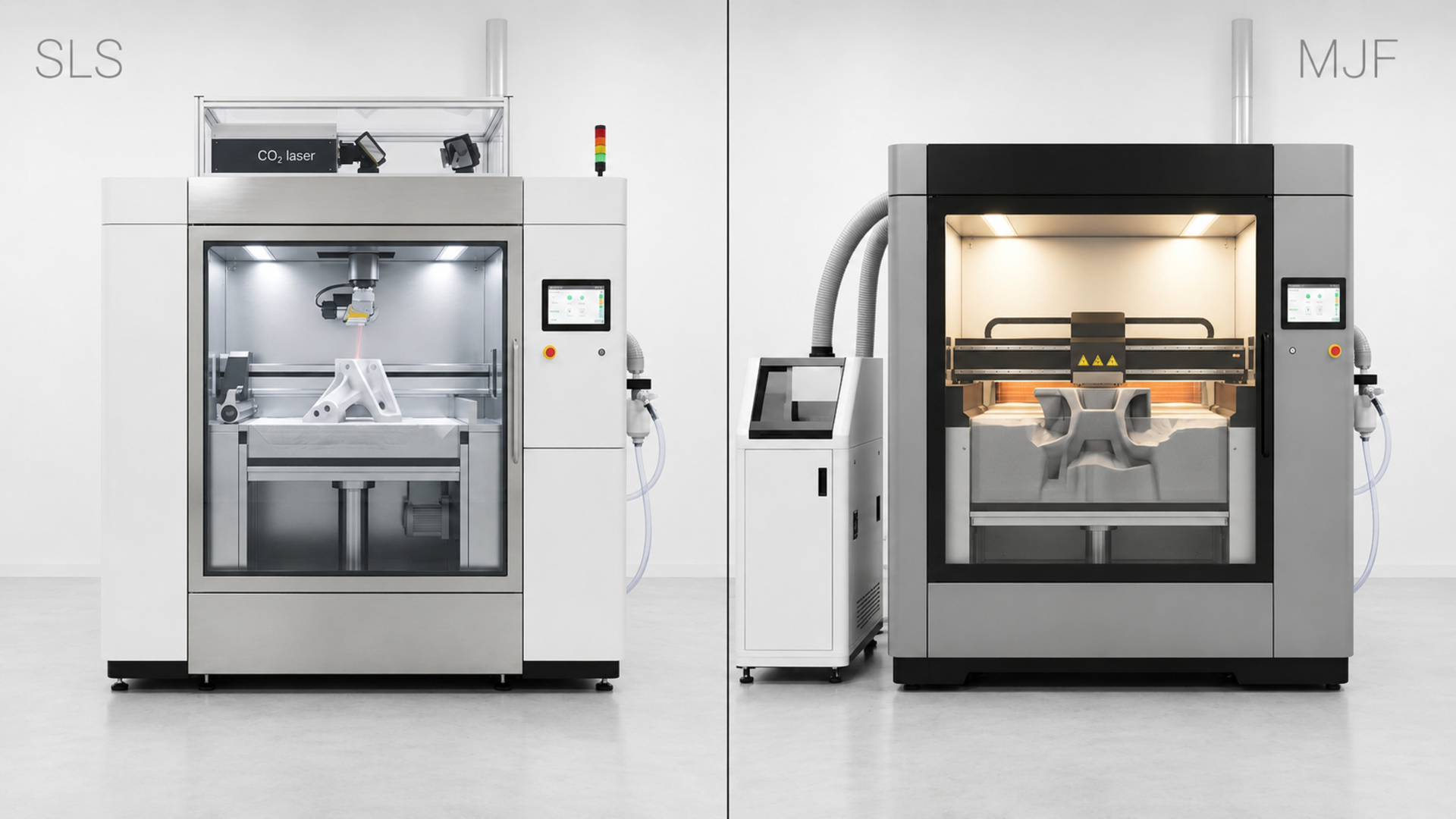
Table of Contents:
Technology Comparison
Selective Laser Sintering (SLS)
Technology description: An industrial rapid prototyping process that uses a laser to fuse powder into parts.
Materials: PA12, PA11, Alumide, flame-retardant and food-grade versions.
Pros: Material variety, large part size capability, excellent mechanical properties.
Cons: Lacks aesthetic finish, requires post-processing.
Common applications: Engine housings, heat-resistant parts, and functional prototypes.
Companies offering SLS 3D Printing Service solutions typically rely on this technology for strong functional components.
Multi Jet Fusion (MJF)
Technology description: An additive manufacturing method that utilizes an inkjet print-head to deposit binding agents on powder beds followed by infrared heating to form parts.
Materials: PA12, reinforced PA12, PA11, TPU.
Pros: Very high precision, excellent detail resolution, fast print speeds.
Cons: Slightly limited material library, non-uniform colors, low impact resistance vs. SLS.
Common applications: Fitted parts, functional prototypes, end-use parts.
Many providers within the 3D Plastic Printing Service industry use MJF for high-detail production runs.
Comparison Of MJF vs SLS Technologies
Selective Laser Sintering uses a CO₂ laser to fuse powder together, whereas Multi Jet Fusion utilizes a combination of binder and infrared light. SLS parts are typically white, while MJF parts are gray, with limited post-processing capabilities such as painting.
A professional 3D Printing Company In Malaysia will often recommend SLS when broader material options are required, including eco-friendly and functional-grade polymers not always available in MJF printing.
MJF excels at creating high-detail prototypes with tight tolerances, while SLS is better for medium to large-sized components and end-use parts.
In terms of consumables, SLS has a more significant initial investment, but MJF has higher operating costs. Both technologies have comparable cooling periods, with parts needing to be cooled for roughly 10–20 hours before removal from the printer.
Build Volume
The build volume of SLS is considerably bigger (550×550×750 mm) than that of MJF (380×284×380 mm), allowing for bigger part sizes or more components per print. This makes SLS a more compelling option for larger-scale manufacturing projects.
Meanwhile, MJF’s smaller build volume is better suited for low-volume production and prototyping runs commonly seen in 3D Printing Products Malaysia workflows.
Interchangeability Of MJF and SLS
The majority of components produced on one platform may be printed on the other since both technologies have nearly identical design rules, with variations in tolerances.
Some typical examples of interchangeable SLS and MJF components are as follows:
- Functional prototypes: Brackets, housings, clips made from PA11, PA12, reinforced PA12
- End-use components: Connectors, housings, gears (small)
- Flexible components: Seals, joints, gaskets made from TPU
These parts are frequently produced by a 3D Printing Company In Malaysia supporting both SLS and MJF workflows.
Choosing The Right Approach
Consider your prototyping and manufacturing objectives when selecting between Multi Jet Fusion and Selective Laser Sintering.
We suggest employing SLS over MJF for:
- Achieving precise color control and brand-specific appearance
- Producing parts for food processing and medical applications
- Manufacturing larger components and high-volume production runs
- Having more process customization options
And MJF is a better option when:
- Time-to-market is a priority
- High-detail, thin-walled prototypes are required
Many manufacturers using ABS Plastic 3D Printing Service workflows also combine multiple technologies depending on prototype stage and testing requirements.
Application In Manufacturing Workflows
Modern production pipelines often integrate solutions for fast iteration and design validation before mass production.
Companies specializing in increasingly combine SLS and MJF to optimize cost, strength, and surface finish across different product stages.
SLS 3D Printing Service In Product Development
Functional prototypes and end-use parts can be created using solutions that support industrial-grade manufacturing requirements.
ABS And Plastic Prototyping Solutions
Early-stage product testing often relies on solutions to validate form, fit, and function before scaling production.
Manufacturing Support In Malaysia
A reliable 3D Printing Company can support both SLS and MJF workflows for prototyping, engineering validation, and production scaling.
End-Use Production Applications
Modern workflows in 3D Printing Products cover everything from concept models to functional end-use parts across multiple industries.
Plastic Fabrication Alternatives
A 3D Plastic Printing is often used to replace traditional tooling in low-volume manufacturing and custom production runs.
Closing Notes
We offer high-quality Selective Laser Sintering services with state-of-the-art EOS P3 NEXT equipment to bring your ideas to life. Consult with us and receive real-time feedback on design for manufacturing.
Additionally, our worldwide manufacturing network can deliver MJF parts, enabling you to take advantage of different prototyping and manufacturing technologies and achieve the best value for your project. We go beyond traditional 3D printing services by helping you get closer to your product development goals.