
Metal 3D Printing vs Die Casting: Which Creates Stronger Parts?
One of the main dilemmas engineers face today is choosing a manufacturing process for metal components. Moreover, a decision between metal 3D printing and die casting makes an even bigger impact on many aspects of manufacturing. According to recent strength comparison tests, parts made via selective laser melting have shown to have 115% tensile strength compared to similar aluminum cast parts. Nevertheless, there are significant drawbacks to 3D printing processes that may negatively affect the service life of the produced components. Businesses looking for a reliable Metal 3D Printing Service In Malaysia can benefit from understanding these performance differences before selecting a manufacturing method.
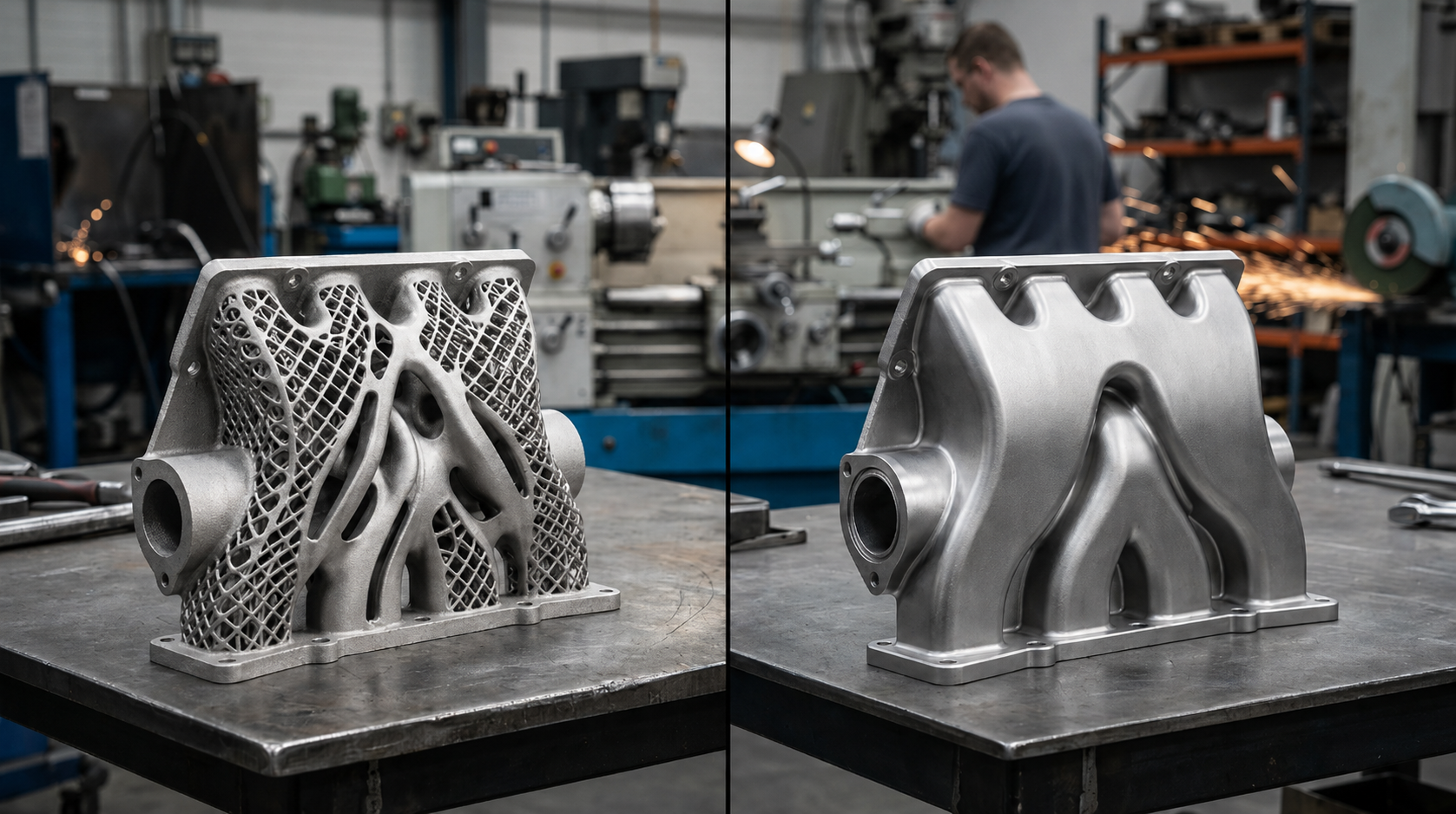
Table of Contents:
- Quick Comparison
- How Do Tensile Strength Results Compare Between Processes?
- AlSi10Mg / A380 Tensile Strength Comparison (MPa)
- Why Does Fatigue Performance Favor Traditional Casting?
- Fatigue Performance: Die Casting vs 3D Printing
- When Does Cost Analysis Support Each Manufacturing Method?
- Which Process Handles Complex Geometries Better?
- Design Freedom: Metal 3D Printing vs Die Casting
- Conclusion
Quick Comparison
The tensile strength is generally higher with 3D printing, offering approximately 15% greater tensile strength than die casting. Fatigue life, however, is better in die casting by around 10–15%. Die casting also provides a finer surface finish, with a roughness of Ra 1–4 μm compared to Ra 10–25 μm for 3D printing. From a cost perspective, the breakeven point is typically between 100 and 500 parts, while lead time is significantly shorter with 3D printing at 2–5 days compared to 8–16 weeks for die casting.
Having learned about general trends in tensile strength, fatigue life, lead time, and cost, it becomes possible to choose a manufacturing process depending on particular circumstances. The four points below will provide a detailed description of why one technology is better in terms of tensile strength, another is superior at fatigue performance, and some factors that make each method cost-efficient.
How Do Tensile Strength Results Compare Between Processes?
It is common knowledge that the metal 3D printing strength depends on many factors. Moreover, it is not the only characteristic that has a significant impact on the metal 3D printing vs die casting debate. To be specific, multiple research papers confirm that tensile strengths of parts made from aluminum alloys via selective laser melting (SLM) are indeed higher than those produced via die-casting. The reason for this is anisotropic grain structure associated with the SLM process, making 3D Aluminium Printing an attractive solution for applications requiring higher tensile strength.
AlSi10Mg / A380 Tensile Strength Comparison (MPa)
The average tensile strength is approximately 460 MPa for SLM 3D printing compared to 400 MPa for die casting. Yield strength is around 10% higher in SLM parts according to tensile test results. The fine-grained structure of SLM parts produces grain sizes that are two to three times smaller than cast parts, and the smaller grain size contributes directly to improved tensile strength.
The tensile strength of 3D printed metal parts tends to be higher due to much more rapid cooling involved during the SLM process. This results in a fine-grained structure that in turn causes an increase in tensile strengths by approximately 15% on average. Nevertheless, tensile properties in 3D printed parts are strongly dependent on the direction of the force relative to the layers. When the force is applied perpendicularly to the layers, tensile strength is lowered by 10–15%, whereas tensile strength is maximized for vertical loading.
Why Does Fatigue Performance Favor Traditional Casting?
When considering the 3D printed metal vs cast parts fatigue strength, it becomes apparent that traditional manufacturing processes have certain advantages. First of all, anisotropy in 3D printed parts results in significantly lower fatigue performance. Fatigue behavior of 3D printed metal parts is governed by stress concentration near defects. Thus, the 3D printed metal surface finish plays a critical role in fatigue life determination. In addition, porosity formed in additive parts results in premature crack initiation.
Fatigue Performance: Die Casting vs 3D Printing
SLM parts demonstrate approximately 1.8 million fatigue cycles at 200 MPa, while die-cast parts achieve around 2.1 million cycles at the same stress level. Surface roughness is another contributing factor, with SLM parts typically measuring Ra 10–25 μm compared to Ra 1–4 μm for die casting. The porosity found in additive manufacturing can also create crack initiation sites. However, fatigue life can be improved by approximately 20–30% after HIP treatment.
The key challenge in fatigue performance of 3D printed parts is a relatively poor surface finish and numerous defects formed during the SLM process. As a result, fatigue life of additive manufactured parts is significantly reduced as compared to its traditional counterparts. For example, fatigue life of SLM 3D printed aluminum alloy is shown to be 1.8 million cycles at 200 MPa, whereas die-cast parts have a fatigue life of 2.1 million cycles. Another major contributor to a lower fatigue life is a relatively large surface roughness of 3D printed parts: Ra 10–25 micrometers in 3D printed parts versus 1–4 micrometers in cast parts. It is worth noting that a HIP treatment can improve the fatigue performance of 3D printed parts by 20–30%. In many cases, however, the additional HIP step is not economically feasible. As a result, there are areas of application where traditional manufacturing processes have a considerable advantage over their additive counterparts.
When Does Cost Analysis Support Each Manufacturing Method?
The die casting cost per part varies depending on production volume. Furthermore, it is crucial to understand how 3D printing cost per part compares to conventional manufacturing methods. Most importantly, it is necessary to consider additional expenses associated with tooling in both additive and traditional manufacturing processes.
Cost Per Part Analysis
For production runs of 1–50 parts, 3D printing is generally 30–50% cheaper because no tooling is required. The approximate breakeven point is around 350 parts. For production volumes exceeding 500 parts, die casting becomes 60–80% more cost-effective. Tooling costs for die casting typically range from USD 20,000 to over USD 100,000, while Aluminium 3D Printing eliminates the need for tooling altogether.
In many respects, the 3D printing lead time advantages determine the final cost per part in the low-volume range. For example, 3D printing allows functional prototypes to be produced within 2–5 working days as opposed to the 8–16 weeks required for traditional tooling. This 3–4× advantage in lead time translates into significant cost savings, especially when many iterations are required in the R&D process. Nevertheless, prototyping is only a small window of the overall production timeline, and the economics of manufacturing change substantially with production volumes. For example, high-volume production of standard parts in electronics manufacturing falls under the cost-efficient category for traditional metal manufacturing. Die casting has a distinct advantage in producing complex parts at high volumes. Notably, 3D printing is superior at minimizing material waste: whereas about 30% of raw material is turned into waste during die casting, metal 3D printing can recycle 95% of waste back into the build. Finally, a crossover point depends on complexity of the part, with high-complexity parts utilizing casting in lower quantity ranges.
Which Process Handles Complex Geometries Better?
The geometry design possibilities of additive manufacturing have been a subject of much discussion. The fact is that the design freedom additive manufacturing provides exceeds the design freedom available in traditional manufacturing processes. Design features only available to 3D printing include minimum wall thickness, internal channels, lattice structures, undercuts, and reduced assembly. It is therefore possible to produce lightweight parts with high complexity via metal 3D printing.
Design Freedom: Metal 3D Printing vs Die Casting
Metal 3D printing supports a minimum wall thickness of approximately 0.2 mm compared to 0.8 mm for die casting. It enables complex internal channels, lattice structures, unrestricted undercuts, and multifunctional designs that reduce assembly requirements. Manufacturers utilizing Aluminium 3D Printing Service In Malaysia can take advantage of these design freedoms to produce lighter and more optimized components.
Additive manufacturing versus traditional casting strength comparison shows that 3D printing allows manufacturers to minimize the weight of parts while maintaining or improving performance characteristics. For example, it is possible to design topology optimized structures that reduce overall weight by 30–40% while keeping the same strength. Moreover, 3D printing allows the implementation of lattice structures, internal channels, and other design features unavailable in traditional manufacturing. On the other hand, complex geometric shapes must be carefully oriented during the printing process in order to ensure sufficient mechanical performance. Overall, advantages inherent in 3D printing design possibilities outweigh the advantages of traditional manufacturing processes. The metal 3D printing vs die casting comparison should also take into account the ability of additive manufacturing to implement features that cannot be achieved using other methods.
Conclusion
The advantages of metal 3D printing and die casting are numerous in particular application areas. To begin with, a choice between 3D printing and die casting is not always obvious since both processes have certain strengths and weaknesses. When comparing tensile strength of materials, aluminum 3D printing proves to be superior due to fine grain structure. This advantage translates into higher tensile strengths for 3D printed parts made using SLM technology. On the other hand, tensile strengths for 3D printed parts are highly dependent on the force application direction. In addition, 3D printed parts show poor performance in terms of fatigue life. Poor surface finish and internal defects decrease fatigue life of 3D printed parts by 15–30% as compared to traditional counterparts.
On the other hand, metal 3D printing provides significant process advantages over conventional manufacturing. First of all, 3D printing has a clear advantage in prototyping and rapid manufacturing, reducing lead time by 5–10×. Another advantage is the possibility to design much more lightweight and complex parts. In terms of costs, 3D printing is cost efficient at low volumes due to no tooling requirements. Nevertheless, the breakeven point for 3D printing versus traditional machining is between 100–500 parts depending on the complexity. In addition to rapid prototyping, 3D printing is ideal for low-volume production of complex parts. At the same time, high-volume production of standard parts benefits from die casting due to much better cost performance ratio. Finally, 3D printing offers significantly reduced material waste as compared to traditional manufacturing processes: between 95% recycled material versus only 30% of material turned into waste.
Whether your project prioritizes strength, design flexibility, or rapid prototyping, selecting the right manufacturing process depends on your production goals and budget. If you’re looking for an experienced 3D Printing Metal Service Provider Malaysia that specializes in 3D Printing In Metals, get in touch with our team to discuss the best solution for your next metal component project.