
3D Printing Design Optimization: Strength Vs. Aesthetics
Designing for 3D printing often requires balancing mechanical properties and aesthetics. Knowing which factors to prioritize can help designers prevent unnecessary redesigns, optimize performance, and shorten time-to-market. In addition, as designs evolve from prototyping to end-use parts, such considerations become even more relevant. Parts frequently need to satisfy mechanical performance requirements for certain applications while also satisfying appearance criteria for cosmetics or assemblies. For projects that require professional design support, 3D Printing Designs Malaysia can help achieve an effective balance between strength and appearance.
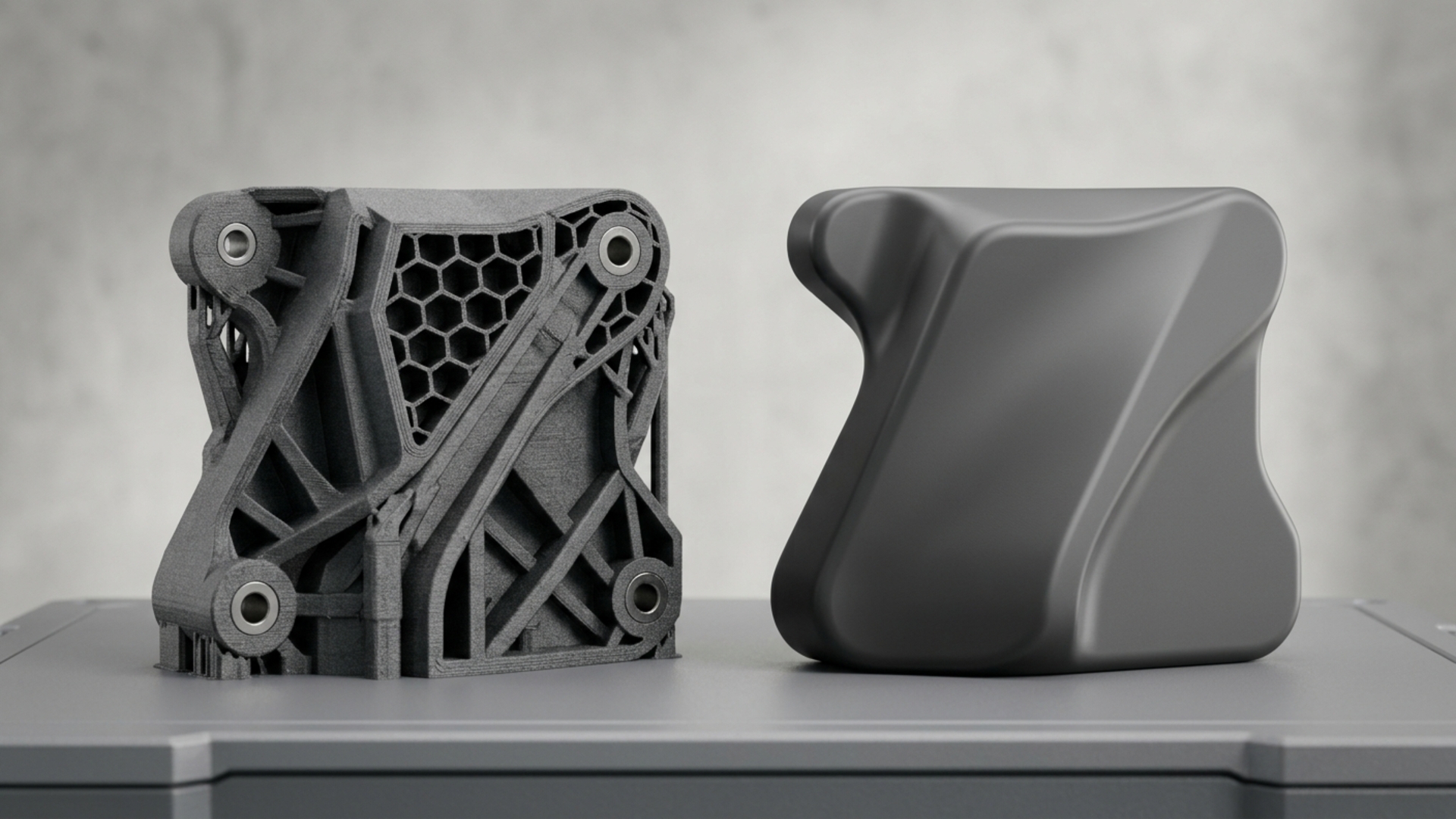
Table of Contents:
The reinforcing elements that improve a part’s mechanical properties are often at odds with cosmetic requirements. For example,
1.thicker walls or reinforcing ribs add strength but can lead to sinks or cosmetic blemishes
2.layered manufacturing approaches such as FDM can lead to weaker isotropic properties
3.surface finish requirements can necessitate additional machining or compromise thin-wall features
Similarly, design choices that improve a part’s performance can compromise its surface roughness, with fine details being especially challenging to reproduce.
The considerations below are critical in achieving a good balance between performance and appearance.
Designing for Mechanical Properties
When designing a part for specific mechanical performance, geometry and material are the most important variables. Wall thickness must be optimized to avoid inducing internal stresses, which become especially critical as part size increases. Additionally, using fillets and radii instead of sharp edges and corners helps to reduce stress concentrations. Placing primary load-bearing features along the expected loading direction offers maximum performance while minimizing material waste. Learn more about design considerations for additive manufacturing.
The choice of materials also has a direct impact on performance. For example, ABS-M30 offers superior strength and stiffness over conventional ABS, making it ideal for functional prototypes and tools. Similarly, nylon-based materials exhibit very good toughness and fatigue resistance, which make them suitable for applications involving cyclic loading. However, carbon-reinforced variants offer improved stiffness and dimensional stability, albeit at the expense of impact resistance. See our overview of materials for 3D printing for more detail.
Designing for Surface Finish
A part’s surface finish quality often depends on the manufacturing process, and the achievable resolution defines the level of detail that can be captured during printing. This consideration is especially important for parts that require a smooth surface appearance for cosmetics or sealing purposes.
While FDM is inherently a lower-cost technology, its mechanical performance characteristics are often better for applications that see frequent use or are subjected to impact. However, FDM’s visibility of layer lines compromises its cosmetic appeal. On some printers, this can be mitigated by careful placement of critical surfaces along a different axis than the printing orientation. In addition, machining can be used to clean up surfaces after printing.
SLA parts, on the other hand, exhibit higher surface quality and finer detail, and they are generally more isotropic. However, their mechanical performance characteristics are often lower for similar materials, which limits their applications to mostly displays and prototyping. SLS parts generally exhibit superior mechanical properties and are also dimensionally stable, but their surface quality is slightly inferior to SLA. MJF parts, however, often offer the best combination of mechanical performance and surface finish.
| Process | Resolution | Strength | Surface Finish |
| FDM | Moderate | Good Visible Anisotropic | Functional Prototypes, Tooling |
| SLS | Fine | Excellent Moderate Isotropic | Functional Parts |
| MJF | Fine | Excellent Fine Uniform Isotropic | Production Parts |
| SLA | Very Fine | Moderate Moderate Smooth Fine | Prototypes |
See our overview of 3D printing services for more information.
Material/Process Combinations to Consider
Certain process-material combinations are particularly well-suited to satisfy both performance and cosmetic requirements.
MJF and PA12 offer a good combination of mechanical performance, surface finish, and material properties for production parts.
SLA with engineering resins can offer acceptable mechanical performance and fine surface detail, albeit with more limited performance characteristics.
FDM with ABS-M30 can deliver good performance at a lower cost, making it ideally suited for indoor use.
These combinations can help to minimize post-processing while also delivering acceptable part performance and cosmetics. When selecting a Custom 3D Printing Malaysia solution, these material and process combinations can help meet both functional and visual requirements.
Post-processing for Strong and Cosmetic Parts
While many post-processing steps can be used to improve a part’s cosmetics, they can also be critical in achieving mechanical performance. The options vary between technologies and include vapor smoothing, painting, sanding, and machining. For example, vapor smoothing can drastically improve the surface appearance of nylon parts with minimal impact on mechanical properties, making it ideally suited for functional parts. Similarly, dyeing and painting can be used to improve appearance or impart additional functionality, such as improved corrosion resistance. By considering such approaches and selecting optimal material-process combinations, it is possible to achieve parts with both desired mechanical performance and a smooth surface finish typical of injection-molded parts.
Post-processing should be considered as part of the broader design process, as it can enable significant optimizations on both sides of the process. Finishing options can also define the overall appearance variability, which can be especially important for parts that require high reprocessing consistency. Designing for post-processing can also shorten time-to-market by significantly reducing the number of required iterations.
Balancing Performance and Appearances in Parts Manufactured Using 3D Printing
As parts transition from prototyping to production, material performance, process reliability, and general reproducibility transform from nice-to-have into absolute musts. The considerations below can help to ensure that parts exhibit required mechanical properties and surface finish. Working with a 3D Printing Company In Malaysia can also help manufacturers select suitable processes and materials based on specific performance and appearance requirements.
Design for 3D Printing
A well-optimized design considers strength, aesthetics, material selection, printing technology, and post-processing from the beginning. For applications that require durable components, Metal 3D Printing Service Malaysia and Plastic 3D Printing Service In Malaysia can provide different options depending on the required material properties, production needs, and desired finish. By considering these factors together, designers can reduce unnecessary iterations and produce parts that meet both functional and visual expectations. If you need support with optimizing your next 3D printing project, connect with our team to discuss your requirements.